
Our efforts in biodiversity documentation have been supported by the Yanadhi community who are knowledge holder. They shared with the team invaluable information on several species of Non Timber Forest Produce (NTFP), their importance and the harvesting methods they adopt for sustainable use of the species. This has resulted in comprehensive documentation of all species – indigenous and rare – as well as in the establishment of a vast germ- plasm.
Projects
Documenting sustainable harvesting practices of NTFPs

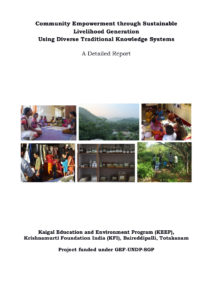
In 2015, a survey was conducted with the objective of documentation of NTFPs collected and sustainable practices among Yanadhi communities in 32 tribal villages on the fringes of KWLS. A field study was conducted for this purpose covering Yanadi Tribal communities living on the fringes of KWLS in 7 Mandals of Chitoor District, Andhra Pradesh. This was completed as a part of a UNDP funded project. The objective of this documentation was to compile knowledge of how traditionally bioresources were harvested and the kinds of bioresources harvested. Such a community based data collection also had the salutary effect on the communities’ sense of self-affirmation about their lives and knowledge. The primary knowledge so gathered can be used to develop sustainable forest management practices as well as develop community enterprises based on forest based and locally available bioresources.
Tracking seasonal data from forests (2012, 2014-15)
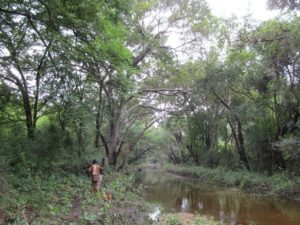
Phenology data involves documenting seasonal changes including flowering, fruiting, leaf shedding and leaf flushing of trees and is a very important activity in conservation. Understanding the variations in productivity each season is vital for sustainable harvesting and hence floral conservation. At the Kaigal Valley, this data has been collected for over 8 years and has helped in recording the appropriate time for fruit and seed collection in order to raise them ex-situ. This information has also helped the livelihood program to monitor the productivity of the different NTFP species and plan the manufacture of their forest produce based goods.
Documenting traditional knowledge on NTFPs
Working closely with the Yanadhi people over many years has built close bonds between the members of KEEP and the tribal community. The members of this community are also known for their knowledge and expertise in folk medicines using wild flora. They have been traditional healers, vaidyas in their localities and some elders continue to be healers even today. Considered sacred, the Yanadhi elders were generous to share this invaluable information with us. Some of the wise elders helped us document the medicinal plants native to this region, the traditional methods of preparation of medicines and their modes of use. This knowledge sharing is also part of the curriculum of the Sanctuary Schools so that the younger generation learn the information passed on from their elders. Students also raise some of these plants around their homes in the tribal hamlets.
Survey of Flora in 80 square km of the forest (2003)
A database on vegetation diversity was initially created through field surveys covering 80 sq. km of the forest. This was done with the help of knowledgeable elders from the tribal communities, local youth and experts in ecology and taxonomy. The field studies revealed the status of the population of the different species, (particularly the NTFP species used by the tribal communities) using which we were able to identify the species that were locally threatened or were becoming rare. This helped in prioritizing the species that needed immediate attention from a conservation perspective. Species so identified were then raised in the forest nursery followed by afforestation and distribution, thus supporting our ex-situ conservation efforts. This initial database has been maintained and updated through regular follow-up and monitoring. The data from these surveys are available in the form of field guide to herbs, shrubs and trees.
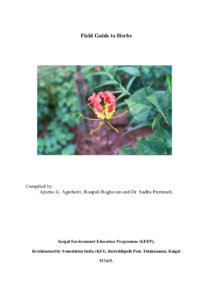 Field guide to herbs | 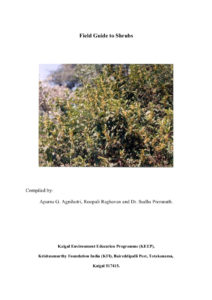 Field guide to shrubs |  Field guide to trees |